What the 15 selected companies reveal about the leading edge of the energy transition
From 475 applicants across 79 countries, 15 companies have been selected as SET Award 2026 finalists – three per category, spanning Clean Energy & Storage, Buildings & Construction, Industry, Mobility & Transportation, and Quality Energy Access & SDG-7. All 15 have paying customers or active pilots, 80% have moved beyond MVP, and 60% generate monthly revenue above €250K.
Clean Energy & Storage
The three finalists in this category share a focus not on generating more renewable energy, but on making existing renewable capacity more useful – through smarter storage, smarter trading, and smarter demand-shifting.
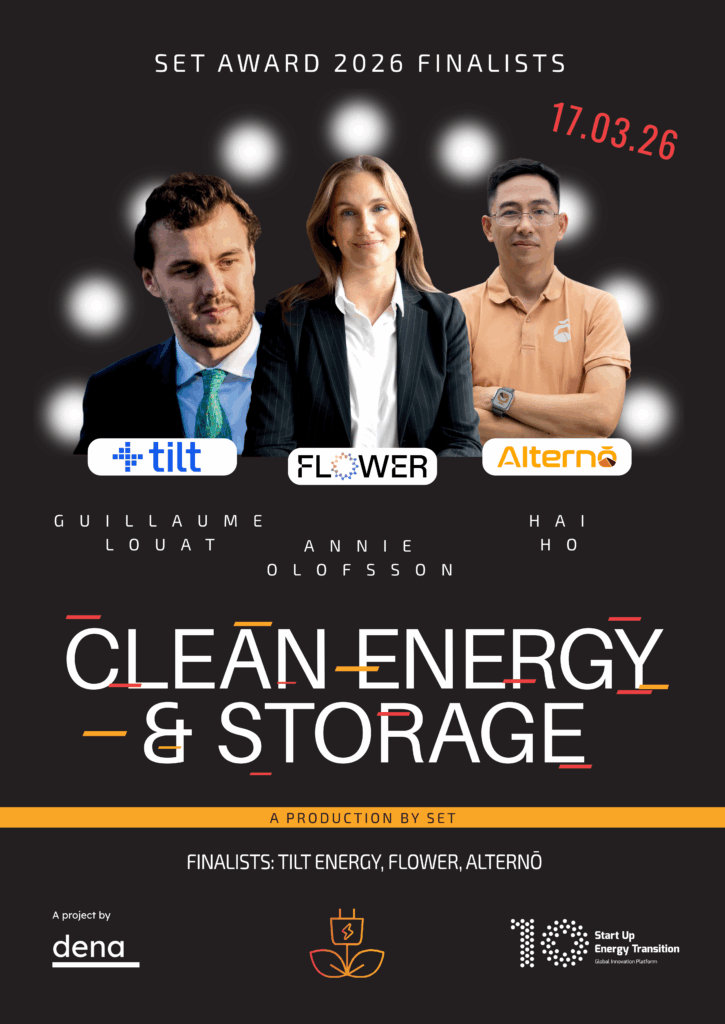
Alterno – Singapore / Vietnam
Alterno builds non-explosive, sand-based energy storage systems that deliver industrial process heat (300-600°C) and electricity from a single unit, using materials – sand, salt, and steel – that are globally abundant and fully recyclable. Founded in 2023 and based in Singapore with operations in Vietnam, the company has moved rapidly from concept to commercial deployment with clients in the food processing and agriculture sectors. Its supply chain model – from R&D to production – is fully controlled in-house, which the company argues allows it to scale faster and cheaper than hardware-dependent competitors.
Flower – Sweden
Stockholm-based Flower is Sweden’s market-leading battery storage trading and optimisation platform, aggregating flexible assets – battery systems, wind and solar farms, EV chargers – and dispatching them across European balancing and spot markets in real time. The company’s end-to-end model spans real-time asset control, prequalification, trading, and PPA offtake, and its Green Baseload contracts give energy-intensive industries access to stable, renewable-sourced electricity – a product whose value grows as grids become more volatile.
Tilt Energy – France
Paris-based Tilt Energy is a demand-response operator certified by French grid operator RTE, whose AI platform forecasts building load profiles, controls heating, cooling, and EV charging assets in real time, and monetises the resulting flexibility on spot and balancing markets – fully CAPEX-free for the customer. The platform serves major retail chains and public institutions in France, and the company has established utility partnerships in the Netherlands and Switzerland for load forecasting services.
Buildings & Construction
The built environment accounts for roughly 40% of global CO2 emissions when both operational and embodied carbon are counted. The three finalists in this category attack that number from different angles: smarter assessment of existing structures, bio-based materials, and waste-derived construction products.

Birdsview – Norway
Bergen-based Birdsview has developed a sensor platform combining AI and full waveform inversion – a method adapted from seismic exploration – that generates real-time, 3D, BIM-compatible maps of reinforcement inside concrete structures without drilling or disruption. The technology allows asset owners to make data-driven decisions about whether to reinforce, reuse, or replace ageing infrastructure, avoiding unnecessary demolition and the embodied carbon it generates. Clients include public infrastructure agencies and major contractors across Europe and North America.
Mykor – United Kingdom
Bristol-based Mykor is commercialising MykoSIP, a structural insulated building panel grown from mycelium and agricultural waste, combining structure, insulation, and cladding in a single prefabricated element with 60% less embodied carbon than conventional alternatives, zero toxic emissions, and a Euroclass B fire rating. Co-founded and led by two women, Olivia Page and Valentina Dipietro, Mykor has secured significant offtake agreements and is establishing a JV-backed production facility in Belgium ahead of commercial launch.
WAS Company – Mexico
Monterrey-based WAS Company transforms complex industrial waste – plastics, mining tailings, and demolition debris – into high-performance construction materials, including Polycrete, a formwork system made from 100% recycled waste that can be reused up to 30 times, reducing construction waste significantly. Founded in 2019 by Walter Mata, recognised by MIT Innovators Under 35 and Forbes LATAM 30 Under 30, WAS Company has received international recognition for the environmental and economic viability of its circular construction approach and operates across Latin America.
Industry
Decarbonising heavy industry is among the most technically demanding challenges in the energy transition. The three Industry finalists approach it through critical materials circularity, AI-driven energy management, and atmospheric carbon removal.

Cyclic Materials – Canada
Toronto-based Cyclic Materials is building a circular supply chain for rare earth elements – the critical materials in permanent magnets found in EV motors, wind turbines, and industrial electronics – at a moment when less than 1% of REEs are recycled globally and China controls over 90% of primary supply. Its proprietary hydrometallurgical process recovers REEs from end-of-life hardware with 61% lower CO2 and 95% lower water use than mined equivalents, and the company has established offtake and partnership agreements with major players across the EV, electronics, and renewable energy sectors in North America and Europe.
encentive – Germany
Neumunster-based encentive offers flexOn, an AI-based energy management platform that automatically shifts industrial electricity consumption to the cheapest and greenest periods without requiring in-house expertise. Targeting energy-intensive companies consuming more than 2 GWh annually, the platform serves clients across German logistics, retail, and food production, and is working with E.ON Group Innovation to extend its reach to utility-managed industrial customers.
InPlanet – Germany
Munich-based InPlanet removes CO2 from the atmosphere through Enhanced Rock Weathering: applying crushed basalt rock to farmland in Brazil, where it captures carbon for over 100,000 years while improving soil fertility and reducing fertiliser use. Its proprietary MRV platform quantifies removal through soil sampling, geochemical modelling, and satellite data, enabling it to issue certified carbon removal credits to corporate buyers across the technology and finance sectors. Named one of Fast Company’s Top 10 Most Innovative Companies in LATAM 2025, InPlanet also offers its MRV methodology as a service to third-party project developers.
Mobility & Transportation
Transport accounts for roughly a third of global greenhouse gas emissions. The three Mobility & Transportation finalists address different parts of the decarbonisation challenge – hardware access, logistics efficiency, and grid-aligned charging – but all three are software-enabled and focused on making clean mobility work for users left out of the transition so far.

CLIP.bike – United States
Brooklyn-based CLIP has developed a plug-and-play e-bike upgrade that attaches to any bicycle’s front fork in five seconds without tools, transforming the 2 billion bikes already in circulation into e-bikes. Its core product retails at €450; its newer BOLT targets low-income urban commuters and livelihood riders in emerging markets at €150 or €5 per month on subscription. Founded in 2018 by MIT design technologist Som Ray, CLIP partners with urban mobility operators, energy utilities, and community organisations across Europe, North America, and emerging markets to scale affordable e-bike access.
Finmile – United Kingdom
London-based Finmile is an AI logistics platform that optimises last-mile delivery route by route and parcel by parcel, reducing fleet energy use and CO2 emissions by up to 40%. Its platform serves global e-commerce brands including JD.com, Temu, TikTok Shop, and Inditex, and has been adopted by logistics providers transitioning to electric and cargo bike fleets. Founded in 2022, Finmile has expanded operations into the US and EMEA and is among the most commercially advanced companies in the finalist cohort.
Gridio – Estonia
Tallinn-based Gridio operates a hardware-free smart charging and solar optimisation platform that automatically shifts EV charging into the cheapest and cleanest hours, cutting driver costs by 30-50% while reducing peak grid demand. Its official API partnerships with Tesla, Mercedes-Benz, BMW/MINI, and the Volkswagen Group provide distribution at scale without hardware investment. The company operates across Europe with utility and automotive OEM partners in multiple markets.
Quality Energy Access & SDG-7
685 million people worldwide still live without electricity access, and progress toward SDG-7 has stalled. The three finalists in this category operate in Nigeria, Rwanda, and India – the regions where the gap is most acute – and share an emphasis on local manufacturing, community-level distribution, and solutions designed around the economic realities of their users.
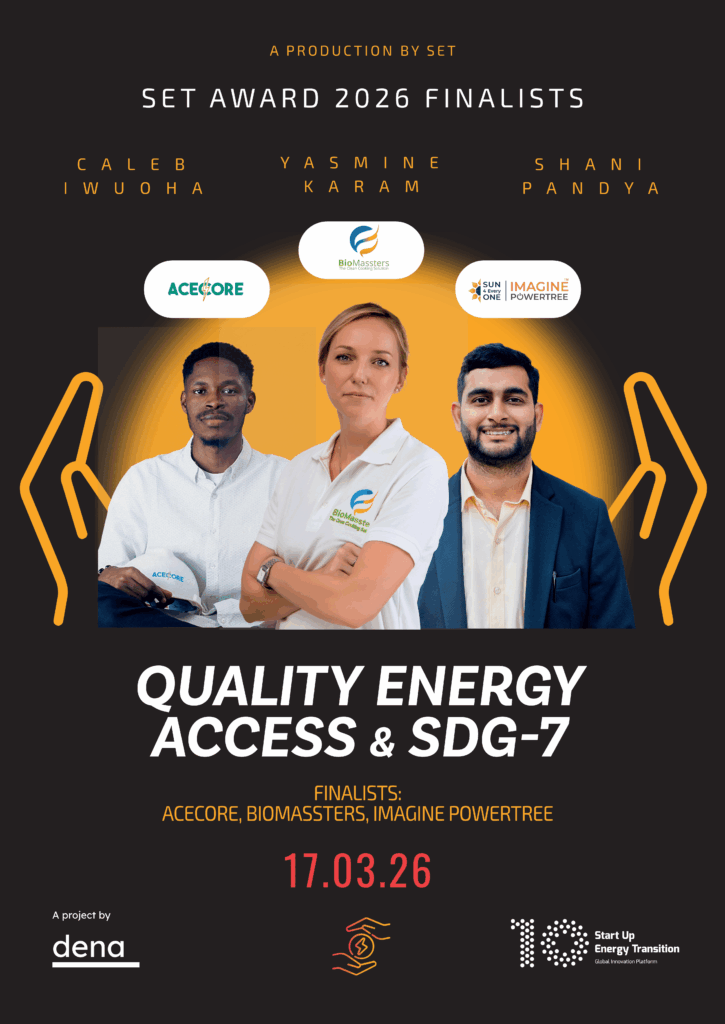
Acecore Incorporations – Nigeria
Port Harcourt-based Acecore manufactures the Powercell, an all-in-one solar battery system paired with the AI-powered Powercore App providing real-time monitoring and predictive maintenance, built locally to lower costs and keep economic value within Nigerian communities. The company has grown its customer base rapidly since launch and is working to expand its product range to serve commercial and industrial users. Founded by Caleb Iwuoha, Chimka Anyanwu, and Chikezie Okoro, Acecore is targeting distribution across Sub-Saharan Africa.
BioMassters – Rwanda
Kigali-based BioMassters manufactures biomass pellets from local waste wood and distributes Tier-4 pellet gasifier stoves – including the Iryacu, the first locally made pellet stove in Africa – as an integrated replacement for charcoal that costs up to 50% less and reduces cooking emissions by 90%. Operating Rwanda’s largest pellet factory, BioMassters is scaling through a school retrofit programme in partnership with Rwanda’s Ministry of Education, and has a majority-female senior leadership team – an intentional part of its model for inclusive economic development.
Imagine Powertree – India
Gandhinagar-based Imagine Powertree builds Building Integrated Photovoltaic and Urban Photovoltaic systems – Solar Trees, Tiles, Facades, and Gazebos – that generate clean energy from surfaces other than rooftops, targeting the dense urban environments across India where rooftop access is limited. Recognised among India’s Top 10 Solar Start-ups by the International Solar Alliance, the company is expanding internationally through partnerships in Mauritius, Canada, and Singapore, with a mission to bring solar access to every community regardless of available rooftop space.
Cohort Insights
Deployment-ready
73% of finalists operate at Late Stage (TRL 7-9), meaning their core technology is stable, deployed, and generating revenue. Only two – Birdsview and Gridio – classify themselves at Mid Stage (TRL 5-6), and both have commercial partnerships and institutional customers. Even Flower, the sole Early Stage classifier, reported revenue exceeding €5M. The energy transition’s bottleneck is no longer invention – it is scaling what already works.
Global spread
The 15 finalists represent 14 countries across five continents. Europe accounts for eight companies, but the distribution is not arbitrary: the SDG-7 category is anchored entirely by companies from Nigeria, Rwanda, and India. Latin America features through Mexico’s WAS Company; Asia-Pacific through Alterno, headquartered in Singapore with operations in Vietnam. The geographic spread mirrors SET Award’s intent: to highlight innovation wherever it is happening, not only where it is easiest to find.
Female leadership above industry average
35% of the total workforce across all finalists identifies as female, well above the IEA’s estimate of approximately 11% for energy start-up founders globally. Buildings & Construction leads: Mykor is co-founded and led by two women, and BioMassters has a majority-female senior leadership team.
AI is the operating layer, not the product
Across all five categories, AI appears not as a product in itself but as the mechanism by which products create value: encentive’s automatic load scheduling, Gridfit’s real-time demand-response trading, Finmile’s parcel-level route optimisation, Gridio’s carbon-aware charging, Acecore’s predictive battery maintenance, Birdsview’s structural diagnostics from sensor data. In each case, AI is not described as a differentiator – it is assumed as infrastructure. In 2026, the question is no longer whether a cleantech start-up uses AI, but how deeply it is embedded in the product’s core value proposition.
The SET Award 2026 winners will be announced live at the SET Tech Festival on 17 March 2026 in Berlin. See the finalists pitch, meet the innovators driving the energy transition, and be part of the moment. Get your tickets here.


