Slashing emissions is no longer enough. To meet our climate goals, we need technologies that actively pull CO₂ from the atmosphere—and fast. Carbon removal startups at the forefront of carbon capture. These three SET100 startups turning innovation into action, scaling solutions that tackle carbon emissions while creating tangible value for industries and ecosystems.
The Carbon Removal Toolbox: From Biochar to Direct Air Capture
Biochar: Turning Ashes into Assets
When it comes to carbon sequestration, biochar is quietly emerging as a climate tech workhorse. Think of it as a two-in-one solution: it locks carbon underground for centuries while turning agricultural soil into a fertility powerhouse.
- What it Does: Biochar is a stable, carbon-rich material created by heating organic waste (like crop residues) in low-oxygen conditions. Once added to soil, it doesn’t just sequester carbon—it boosts water retention, enhances soil health, and increases crop yields.
- The Impact: Could sequester up to 1.2 gigatons of CO₂ annually by 2050, equivalent to the emissions of 260 million cars.* That’s more than the combined emissions of countries like Spain and Italy!
But here’s where the real story kicks in. Enter Takachar, a 2024 SET Award finalist from India, reshaping biochar’s accessibility. Tackling two of the biggest agricultural pain points—open-air burning and waste management—Takachar has built portable, small-scale biochar systems that bring carbon sequestration straight to the field.
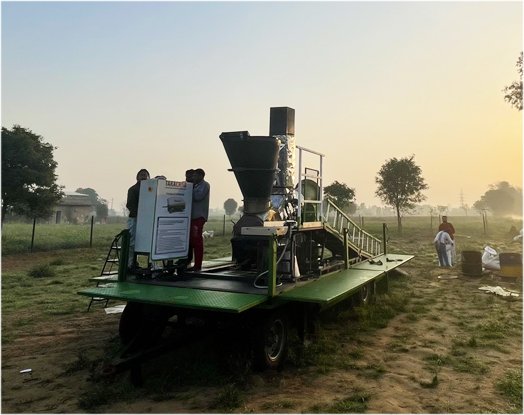
Takachar’s portable biochar at work. Image: Takachar
Unlike industrial-scale solutions, Takachar’s units can be mounted on the back of a tractor, processing agricultural residues where they’re generated. For farmers, this eliminates the toxic emissions caused by burning crops—reducing smoke by up to 98%—while transforming waste into value.
Takachar has already partnered with 5,500 farmers, processing 9,000 metric tons of agricultural residues to date. At scale, their portable systems have the potential to lock away gigatons of CO₂ annually, all while eliminating toxic emissions from open-air burning.
Direct Air Capture: High-Tech Carbon Sinks
When most people think of carbon removal, Direct Air Capture (DAC) is what comes to mind: futuristic machines pulling carbon dioxide straight out of the atmosphere. At its core, DAC offers a tantalizing promise—undoing decades of emissions by literally vacuuming CO₂ out of the air. But as with any breakthrough technology, the road to commercial viability isn’t without obstacles.
- What it Does: DAC uses a series of chemical and physical processes to filter carbon dioxide from air. Once captured, the CO₂ can be stored underground for permanent removal or repurposed for applications greenhouse enhancement.
- The Impact: Could remove up to 10 gigatons of CO₂ annually by 2050, making it a cornerstone technology for achieving net-zero goals.*
It’s a compelling solution, but it faces two critical hurdles—cost and scale. Current systems can consume as much as 2,000 kWh of energy to capture just one ton of CO₂, and costs hover between $250 and $600 per ton, far above what most carbon markets currently pay.* Critics argue that while DAC sounds great on paper, its reliance on clean energy and high costs limit its near-term viability.
That’s where Carbominer, a Ukrainian startup and SET100 2020 alum, is rewriting the narrative with a more practical approach. Their modular units integrate dry and wet CO₂ capture methods, reducing energy consumption compared to bulkier, centralized plants.
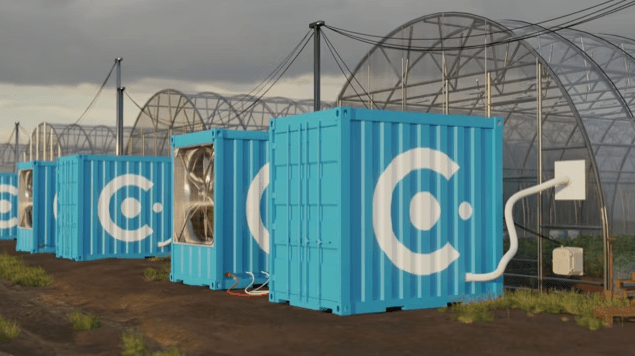
A rendering of Carbominer’s units in effect. Image: Carbominer
Designed for on-site deployment, these units can be installed at industrial facilities or greenhouses, where captured CO₂ is immediately reused—lowering transport costs and adding value. Each unit captures 50 tonnes of CO₂ annually, and their modular design means the system scales incrementally, making it far more accessible for industries not ready for massive, costly infrastructure.
While DAC’s gigaton ambitions are a work in progress, solutions like Carbominer’s address skepticism head-on: smaller, smarter systems that make carbon capture feasible today.
Enhanced Weathering: Rocking Carbon Storage
If carbon removal had a natural ally, it would be enhanced weathering—a solution inspired by Earth’s own geology. By spreading finely crushed basalt rock across farmland, enhanced weathering accelerates the natural reaction between minerals and atmospheric CO₂, transforming it into stable carbonate formations.
- What It Does: Leverages natural mineral reactions to lock CO₂ into rock formations while enriching soil with essential nutrients.
- The Impact: Could absorb 2–4 gigatons of CO₂ annually—while enhancing soil health and boosting agricultural productivity.*
Leading the charge is UNDO, a UK-based 2021 SET100 alum that has turned basalt rock into a scalable carbon sink. Partnering with over 337 farms, UNDO has spread 288,210 tonnes of basalt to date, with the removal potential of 56,900 tonnes of CO₂.
By 2025, they aim to remove 1 million tonnes of CO₂ annually.
Why This Matters: The Tangible Impact of Carbon Removal
A Trillion-Dollar Opportunity
Money talks—and increasingly, it’s speaking the language of carbon removal. Beyond its environmental necessity, carbon removal is emerging as an economic powerhouse, with the industry projected to hit $1 trillion in market value by mid-century. As businesses and governments pivot to decarbonization, the influx of capital into carbon markets isn’t just supporting climate goals—it’s creating economic opportunities.
The Bigger Picture
The potential is staggering—together, biochar, DAC and enhanced weather could remove 10–20 gigatons of CO₂ annually by 2050, addressing up to half of the reductions needed to keep global warming below 1.5°C. That’s not a hopeful projection—it’s a lifeline.
Startups like Takachar, Carbominer, and UNDO are at the forefront of this transformation. What sets them apart is their ability to close the loop—turning captured carbon into a resource that boosts soil health, enhances crop yields, and supports greenhouse operations. By aligning carbon removal with real-world value creation, they’re proving these technologies can be both commercially viable and critical to climate action.
For carbon removal to deliver on its promise, however, it must scale from innovation to infrastructure. Policy alignment, CO₂ transport networks, and verification systems will be essential to turning today’s startups into tomorrow’s gigaton-scale solutions.
Sources
- European Commission. (2024). European Green Deal: Climate neutrality by 2050.
- Garzaron, L., & Viton, R. (2021). The investment case for biochar: A journey towards enhanced sustainability & net-zero emissions. Valoral Advisors.
- Mannion, P., Parry, E., Patel, M., Ringvold, E., & Scott, J. (2023). Carbon removals: How to scale a new gigaton industry. McKinsey Sustainability.
- Smith, P. (2023). Soil carbon sequestration and biochar as negative emission technologies. Institute of Biological and Environmental Sciences, University of Aberdeen.
- Joseph, S., Cowie, A. L., Van Zwieten, L., Bolan, N., Budai, A., Buss, W., Cayuela, M. L., Graber, E. R., Ippolito, J. A., Kuzyakov, Y., Luo, Y., Ok, Y. S., Palansooriya, K. N., Shepherd, J., Stephens, S., & Weng, Z. (2021). How biochar works, and when it doesn’t: A review of mechanisms controlling soil and plant responses to biochar. GCB Bioenergy, 13(7), 1731–1764. https://doi.org/10.1111/gcbb.12885
- Roberts, K. G., Gloy, B. A., Joseph, S., Scott, N. R., & Lehmann, J. (2010). Life cycle assessment of biochar systems: Estimating the energetic, economic, and climate change potential. Environmental Science & Technology, 44(2), 827–833. https://doi.org/10.1021/es902266r
- Elias, M., Hunt, J., Remucal, J., Saksa, P., & Sanchez, D. L. (2022). Biochar carbon credit market analysis: Examining the potential for coupled biochar and carbon credit production from wildfire fuel reduction projects in the Western U.S. Blue Forest Conservation and Pacific Biochar.
- Steiner, C. (2010). Biochar mitigation of climate change and soil restoration. Deutsche Gesellschaft für Internationale Zusammenarbeit (GIZ) GmbH.


